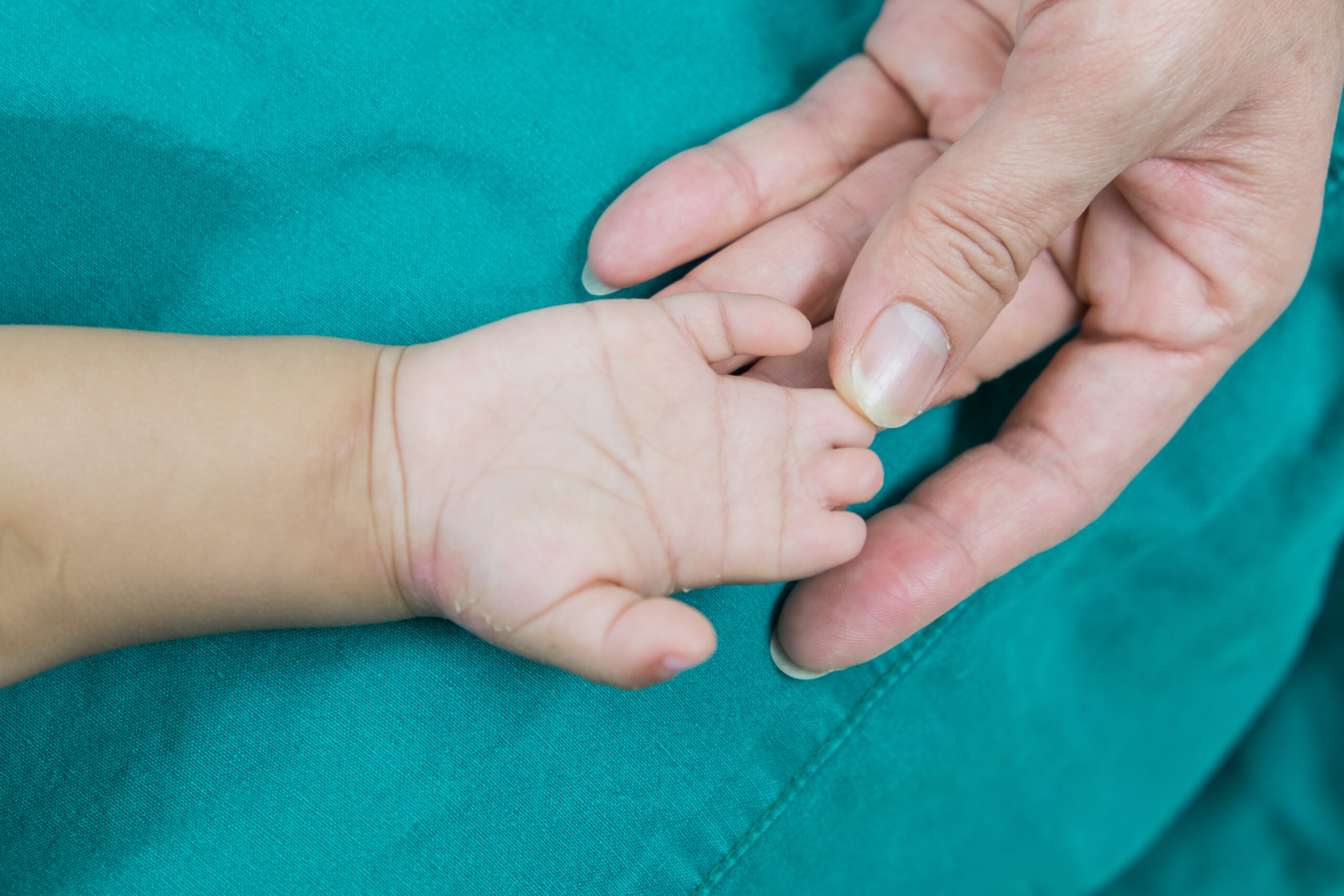
Finding out that your child has a hand difference can feel overwhelming, but it is important to remember that these conditions are highly treatable. In pediatric orthopedics, our mission is twofold: function and confidence. Our goal is to ensure your child’s hand can perform the complex tasks of daily life while also focusing on a natural appearance that allows them to grow up without hesitation. With early intervention we can often optimize a child’s natural growth to achieve the best possible results. Below is an outline of common congenital hand differences to help you navigate the journey ahead towards your child’s full potential.
Syndactyly (Joined or Webbed Fingers)
Syndactyly is one of the most common hand differences. It occurs when the fingers do not fully separate into individual digits during the sixth to eighth week of pregnancy. Fingers can be joined only by skin (simple) or may share bone and nail structures (complex). Surgery is recommended between 12 and 24 months of age to separate the digits, allowing each finger to grow and move independently. It occurs 1 in every 2,000 to 3,000 births. In most cases, a single surgery is all that is needed. If multiple digits are involved, this may be performed in a staged fashion.
Polydactyly (Extra Digits)
Polydactyly involves the presence of an extra finger or thumb. Some digits develop as a rudimentary digit connected by a small skin bridge. This type of polydactyly can often be treated by an in-office procedure, like the clamping of the umbilical cord. However, these extra digits can sometimes share parts – tendons or joints. To optimize function and limit subsequent angulation of the digit, it is critical to address these shared parts, not just remove the digit. It is also one of the most common hand differences, occurring in 1 in every 500 to 1,000 births.
Thumb Polydactyly: Because the thumb is vital for “pinch” and “grasp,” surgery here is more intricate. In addition to removing the smaller thumb; we often combine elements to create one strong, functional digit.
Post-axial Polydactyly: An extra finger on the pinky side. This is often a small, non-functional “nubbin” that can be corrected early in life.
Thumb Hypoplasia (Underdeveloped Thumb)
The thumb may be smaller than usual, lack certain muscles, or be completely absent. If the thumb is present but weak, we can transfer tendons from other fingers to strengthen it and stabilize unstable joints within the thumb. If the thumb is absent, we may perform a pollicization, a procedure where the index finger is moved into the thumb position to restore full function.
Camptodactyly and Clinodactyly (Curved Fingers)
While they sound similar, these conditions affect the fingers in diverse ways:
Camptodactyly A permanent forward bend (flexion) at the middle joint of the finger, most commonly the pinky. It can be caused by tight tendons or muscles. Most cases respond well to stretching and splinting. In severe contractures, sometimes release of the joint and skin grafting is necessary.
Clinodactyly A sideways curve of the finger. This is caused by a bone (the middle phalanx) being shaped like a triangle or trapezoid rather than a rectangle. Surgery is only necessary if the curve is severe enough to cause fingers to overlap when making a fist or if the curvature is progressive. X rays help us delineate if the finger is changing or is likely to continue to change with growth.
Finger Brachydactyly
This is a broad term for fingers that are smaller than normal or incomplete. The severity varies from a finger that is just slightly shorter or angled to a hand where only small “nubbins” are present. Often, children with brachydactyly are incredibly adaptive, finding unique ways to tie shoes or play instruments. Therapy and adaptive equipment are the primary focus with some patients benefiting from surgery for angular deformities or webbing.
A Note to Parents: Every child is unique, and treatment does not always mean surgery. Most children with hand differences do not feel limited until they reach an age where they notice they look different from their peers. Therapists and support groups are key to the development of a confident child born with a hand difference. By thoroughly evaluating your child’s specific anatomy and functional needs we will develop a tailored treatment strategy designed to maximize their independence and help them navigate the world with confidence.
It is important to take your child to pediatric specialists who are experts in treating only kids. At Children’s Orthopaedic and Scoliosis Surgery Associates, LLP our board certified, fellowship trained, specialists provide the best child-friendly care using the latest cutting-edge technology that results in the safest and most accurate outcomes. Please call our office at (727) 898-2663 to schedule an appointment.
Medically reviewed by Lee G. Phillips, MD Board Certified Orthopaedic Surgeon.
Children’s Orthopaedic and Scoliosis Surgery Associates LLP provides information and articles as a service to our readers. No content on this site, regardless of date, should ever be used as a substitute for direct medical advice from your doctor or other qualified clinician. This blog provides general information and discussions about health and related subjects. The information and other content provided in this blog, or in any linked materials, are not intended and should not be construed as medical advice, nor is the information a substitute for professional medical expertise or treatment, If you have a medical concern, you should consult with your health care provider or seek other professional medical treatment. If you think you may have a medical emergency, call your doctor or emergency services immediately. The opinions and views expressed on this blog and website have no relation to those of any academic, hospital, health practice or other institution.