When your child is diagnosed with scoliosis or another spinal condition, choosing the right specialist can feel overwhelming. You may see terms such as orthopaedic surgeon, spine surgeon, pediatric orthopaedic surgeon, and pediatric spine surgeon. What do those differences mean for your child?
Understanding a surgeon’s training and experience, along with the pediatric spine program and hospital team caring for your child, can help your family make an informed decision.
Children’s bones and spines are still developing. Growth plates, skeletal maturity, and the amount of growth remaining can influence how an orthopaedic condition is diagnosed and treated.
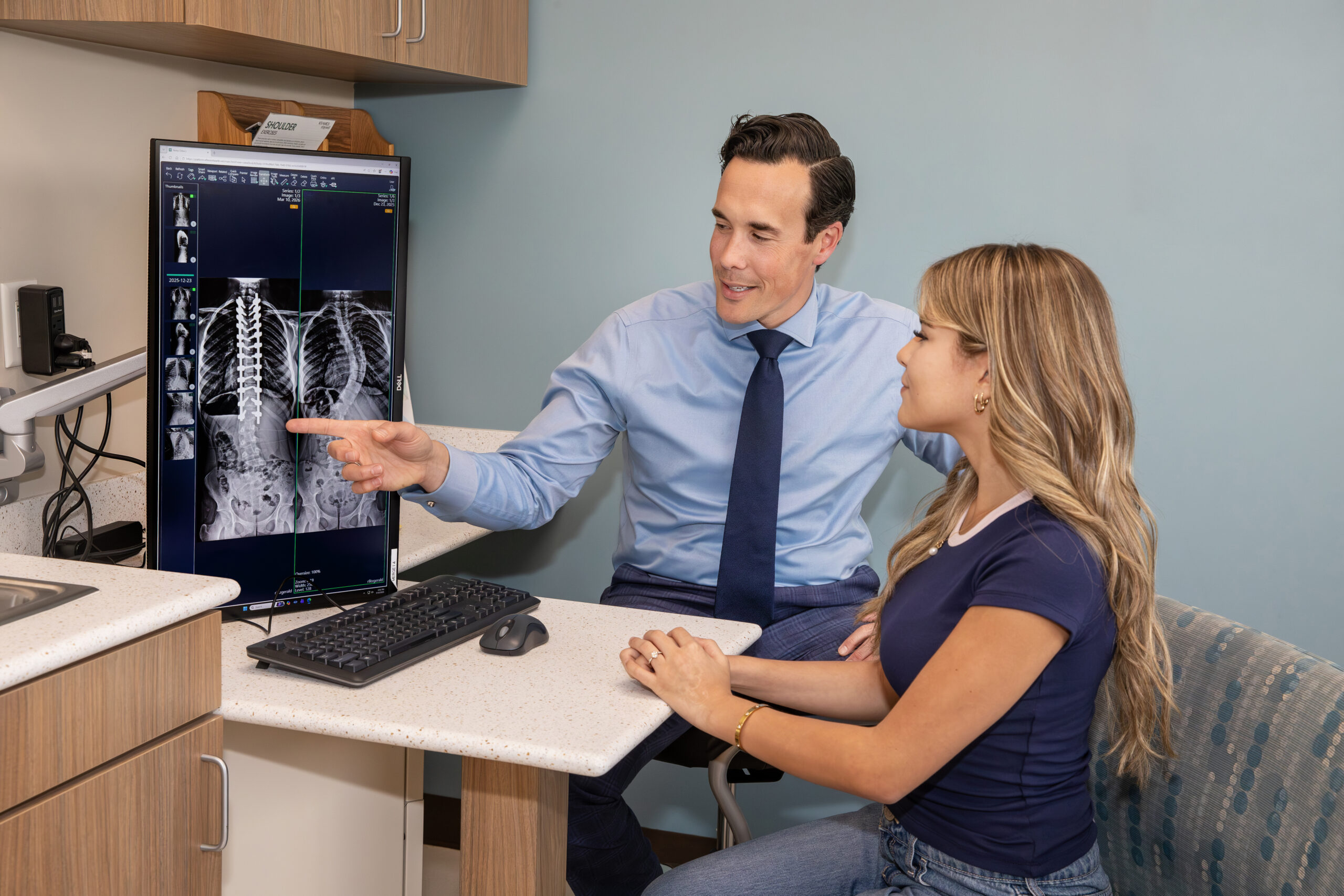
Children’s bones can also remodel as they grow, and even their X-rays look different from those of adults. For a child with scoliosis, treatment involves considering not only the curve that exists today, but also how much growth remains and how that growth may affect the spine in the years ahead.
All orthopaedic surgeons complete extensive medical and surgical training, and some pursue additional fellowship training after residency.
A spine fellowship provides advanced training in conditions of the spine and may include adults, children, or both. A pediatric orthopaedic fellowship focuses specifically on musculoskeletal conditions affecting growing children and adolescents. Some pediatric orthopaedic surgeons then devote a significant portion of their practice to pediatric spinal deformity.
Instead of simply asking, “Does this doctor perform spine surgery?”, parents may want to ask: “What training and experience does this surgeon have treating children with spinal conditions like my child’s?”
That distinction matters. An otherwise healthy teenager with adolescent idiopathic scoliosis may have very different needs from a young child with early-onset scoliosis or a child with a congenital or neuromuscular condition.
Parents may also want to ask whether their surgeon participates in professional organizations focused on spinal deformity, such as the Scoliosis Research Society (SRS).
Choosing a pediatric spine surgeon is only part of the decision. Parents should also consider the depth and experience of the pediatric spine program surrounding their child.
COSSA’s pediatric spine team performs more than 150 surgeries each year for adolescent idiopathic scoliosis and neuromuscular spinal deformity, ranging from routine to highly complex cases at Johns Hopkins All Children’s Hospital.
Parents should also ask who would care for their child if the primary surgeon were unavailable. Does the program have another surgeon experienced in pediatric spinal deformity who can provide appropriate coverage if an urgent problem develops or an unexpected reoperation is necessary?
Having multiple pediatric spine surgeons also provides the ability to use a two-surgeon approach when appropriate. Research comparing dual-attending and single-surgeon approaches in pediatric spinal fusion has found that a two-surgeon approach may reduce operative time and blood loss, with some studies also reporting reduced transfusion requirements and shorter hospital stays.
At COSSA, a collaborative two-surgeon approach can be used for pediatric spinal deformity procedures when appropriate for the individual patient.
In addition, a dedicated spine team is utilized for anesthesia, nursing, neuromonitoring, and surgical technicians. This dedicated team helps ensure safety and improves the patient experience.
Pediatric spinal fusion requires more than an experienced spine surgeon. Our patients are supported by pediatric anesthesia professionals experienced in complex spine procedures who work alongside the surgical and neuromonitoring teams throughout surgery, with particular attention to safety, blood management, spinal cord monitoring, and pain control.
Drs. Ryan Fitzgerald and Alexander Sanders also utilize Stryker’s Airo TruCT and Q Guidance System, which provide detailed, real-time visualization of the spine and assist with the precise placement of spinal instrumentation. The Q Guidance System’s Spine Guidance Software was the first spine navigation software to receive FDA clearance for use with pediatric patients.
Combined with intraoperative neuromonitoring, which allows the surgical team to monitor spinal cord and nerve function throughout the procedure, these technologies provide additional tools during complex pediatric spine surgery.
For children with additional medical conditions, a multidisciplinary children’s hospital also provides access to pediatric subspecialists who can help manage their needs before, during, and after surgery.
Children may be nervous about an examination, X-ray, brace, cast, or surgery. Pediatric teams are accustomed to communicating at a child’s developmental level while also helping parents understand the diagnosis and treatment plan.
The goal isn’t simply to treat an X-ray. It is to care for the child as a whole while considering how today’s treatment may affect growth and development in the years ahead.
Parents should feel comfortable asking questions before making an important decision about their child’s care:
For a significant diagnosis or treatment decision, families should also feel comfortable seeking a second opinion.
COSSA’s roots in pediatric orthopaedics date to July 1988, when Sheila M. Love, MD, became the first pediatric orthopaedic specialist at All Children’s Hospital.
In September 1991, Jeffrey B. Neustadt, MD, joined the practice, bringing fellowship training in pediatric orthopaedics and scoliosis surgery. Gregory V. Hahn, MD, joined in September 1999 and worked alongside Dr. Neustadt caring for children with scoliosis and other spinal conditions. Together, they helped establish the pediatric spine program and collaborative approach to spine care that became an important part of COSSA’s history.
That tradition continues today with Ryan E. Fitzgerald, MD, and Alexander T. Sanders, MD, caring for children and adolescents with scoliosis, kyphosis, and other spinal conditions.
There isn’t one credential that determines which surgeon or program is right for every child.
Training matters. Pediatric experience matters. Experience with your child’s particular condition matters. And the depth and experience of the pediatric team surrounding your child matter.
Ask questions about the surgeon, the program, and the resources available to your child. Parents don’t need to become experts in pediatric spinal deformity, but they should feel confident that the team caring for their child has the training, experience, and resources their child’s condition requires.
It is important to take your child to pediatric specialists who are experts in treating only kids. At Children’s Orthopaedic and Scoliosis Surgery Associates, LLP our board certified, fellowship trained, specialists provide the best child-friendly care using the latest cutting-edge technology that results in the safest and most accurate outcomes. Please call our office at (727) 898-2663 to schedule an appointment.
Medically reviewed by Alexander Sanders, MD Board Eligible Orthopaedic Surgeon.
Children’s Orthopaedic and Scoliosis Surgery Associates LLP provides information and articles as a service to our readers. No content on this site, regardless of date, should ever be used as a substitute for direct medical advice from your doctor or other qualified clinician. This blog provides general information and discussions about health and related subjects. The information and other content provided in this blog, or in any linked materials, are not intended and should not be construed as medical advice, nor is the information a substitute for professional medical expertise or treatment, If you have a medical concern, you should consult with your health care provider or seek other professional medical treatment. If you think you may have a medical emergency, call your doctor or emergency services immediately. The opinions and views expressed on this blog and website have no relation to those of any academic, hospital, health practice or other institution.